
(Written based on information as of November 2026.)
To put the conclusion first: I think the parts of SEO that consist of researching, diagnosing, suggesting fixes and reporting can be handed to AI. Deciding whether to make a change, and writing the things only you can write, should stay with a human. And when I actually ran the loop once, the first thing I learned was that the bigger trap is not the problem the AI finds, but judging whether a fix actually worked.
In this post I want to describe the SEO loop I built for this site together with AI, and what happened in its first round.
It started with an "SEO loop" diagram I saw online
For the past few months, I have been using AI as an agent (an AI that takes instructions and gets work done on its own, using tools along the way), and trying out all sorts of ways to hand it the running of this site, traffic analysis and small day-to-day tasks. In the middle of that, I came across a diagram online titled “The SEO loop.” Find the posts that already rank, find the next keywords, write a brief, write the pages, and have a human approve and publish them. After publishing, check Search Console every morning, write a report every Monday, update the posts that are winning, and go back to looking for the next keywords. In this loop, the human’s only job was “approve and publish.” Everything else belonged to the AI.
I run this site as a place to share information that helps people who want to make a living from music. But I also have a day job, so my time is limited. I think many musicians are in the same position. Time goes to non-musical work like distribution paperwork, promotion and updating a website, and that time is taken away from the music they actually want to make. To get more people reading within that limited time, I thought this idea could be used as it is.
But is it really fine to copy this as is for a personal site?
Two reasons it can't be copied as is
The answer was: the shape of the loop can be copied, but two parts need to change.
The first is the writing step. In the diagram, the AI writes the pages, but Google’s spam policies treat “scaled content abuse,” generating many pages primarily to manipulate search rankings, as a violation. The policy was introduced in March 2024, and Google explains that it judges by purpose and by value to readers, not by whether a human or an AI wrote the content. Google’s guidance on generative AI also says that using it to produce many pages without adding value for users may violate this policy.
Besides, I think the reason the posts on this site get read is the first-hand experience in them: repairing my own gear, running my own label. If I replaced that with AI, I would lose not only rankings but the very reason to write.
The second is the number of readers. A personal site gets few visitors, so day-to-day ups and downs are mostly noise. If I made decisions by looking at the numbers every morning, I would be pushed around by that noise.
So what did I hand to the AI, and what did I keep for myself?
What I gave to the AI, and what I kept
What I gave to the AI goes as far as reading the numbers and suggesting fixes. I use Claude (Claude Code), with read-only access to Google Search Console (a tool that shows impressions, clicks and average position in search results) and to Google Analytics.
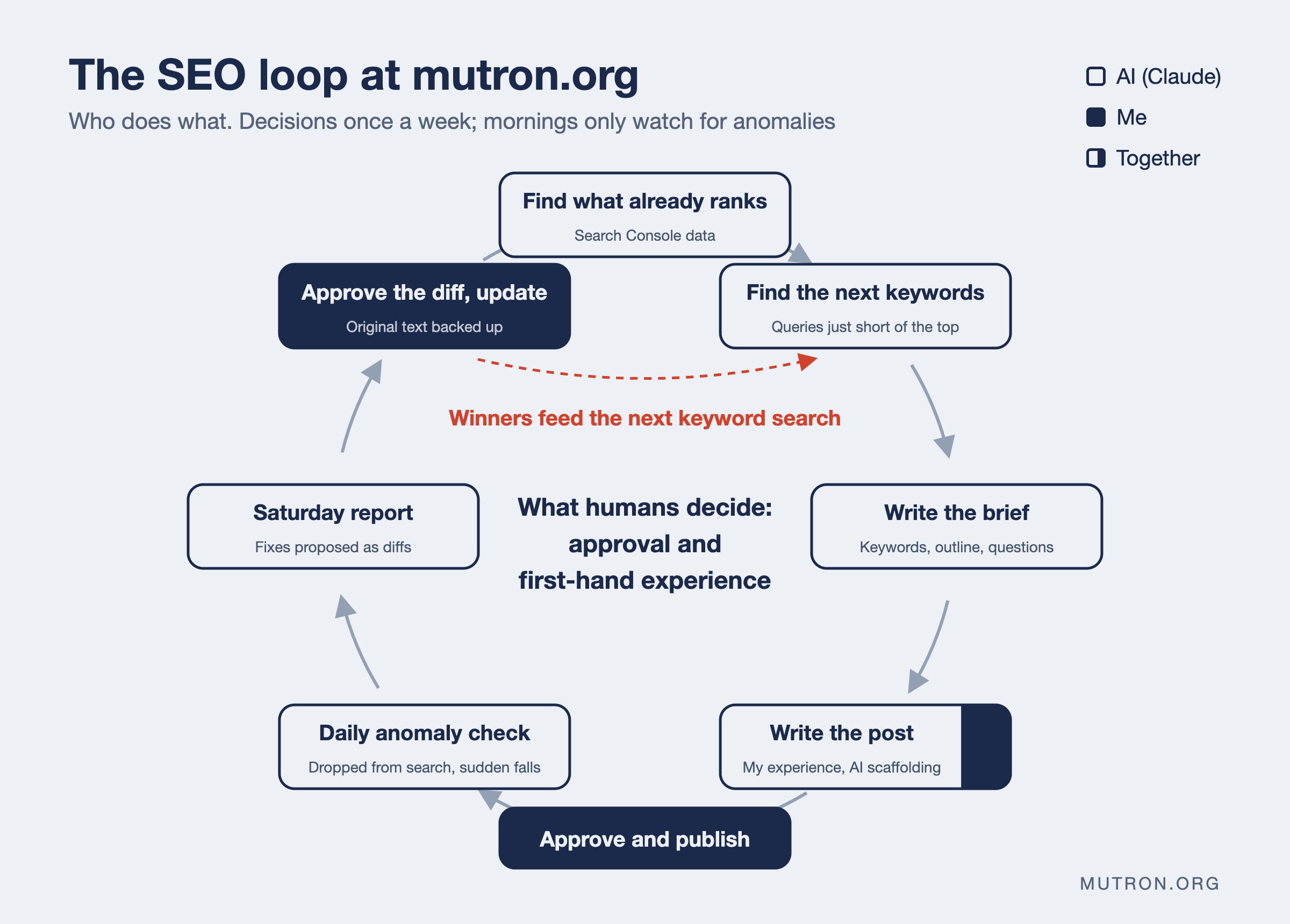
In the diagram, the outlined boxes are the AI’s jobs and the filled boxes are mine. The AI lists the posts that rank well and the queries that are just short of the top, diagnoses where each post is losing readers, and proposes fixes as a diff, “original text → revised text.” The morning check and the Saturday morning report are also the AI’s jobs. What I do is look at the diff and decide whether to make the change, and write the things only I can write.
I limited the morning check to anomalies (dropping out of search results, sudden falls) because of the noise problem above. Decisions are made only once a week. I put the weekly report on Saturday morning because Saturday night is when I can sit down and look at the numbers calmly.
When a post is changed, the original text is always saved first so it can be restored at any time. I also decided not to change the main point of a post. If a post turns out to be read for a search intent different from what it was written for, I write a new post that answers that intent.
So what turned up in the first round?
The first find: a post that ranks but doesn't get clicked
The target was the post that gets read the most on this site, about fixing hydrolysis (sticky, degraded rubber and plastic) on music gear. It appeared at positions 3 to 8 for Japanese searches such as “hydrolysis ethanol,” yet its click-through rate over the last four weeks had dropped to less than a third of its usual average.
The suspect was the description shown in search results. The post had no custom description, so the beginning of the body was cut off automatically, ending mid-sentence with “this is actually caused by a phenomenon called hydrolysis.” People searching want to know whether ethanol really removes the stickiness, but neither the answer nor the fact that I actually restored an Ableton Push came across in the search results. So I changed the description to one that begins: “A real example of restoring an Ableton Push (1st gen) that had turned sticky from hydrolysis, by wiping it with anhydrous ethanol and repainting it with sandpaper and surfacer at home.”
Up to this point, it is a fairly common SEO improvement story. What really made me think came next.
Can I say the fix worked?
To put it first: not by comparing it with the period right before.
At first, I planned to compare the click-through rate of the four weeks before the change with the rate after it. But when I looked back over the past eight months, those four weeks turned out to be an unusually low period. In that case, the next period is likely to return to the normal level even if I do nothing. Statistics calls this “regression to the mean”: after an extreme value, the next value tends to be closer to the average. Had I compared only with the period just before, I would have mistaken that natural recovery for the effect of the new description.
Then why not run an A/B test? Unfortunately, Google’s search results show only one version of each page. You can’t serve two versions of the same post and compare them.
So I decided on the following. Compare against the average over a longer period, not against the period just before. Compare with the click-through rate of other posts over the same period, to check whether something simply changed on Google’s side. And write down, before making the change, the line for “this much higher means it improved, this much lower means I revert, and anything in between means I hold off on judging,” so that I can’t interpret the result conveniently afterwards. On top of that, I record every change and look back over them every month. I think what works becomes visible not from a single change but from the accumulation.
Also, even if you can’t compare two versions of the same post, you can publish posts with different angles separately and see which one gets read. If they target the same query, your own posts compete with each other for rankings, so the target queries need to be kept apart, but I think a personal site can still do something close to an A/B test this way.
So what does this mean for independent creators?
Getting found by someone, somewhere in the world, with little time
Now that much of the SEO work can be handed to AI, I think independent creators can spend their time on what only they can write.
SEO used to be work that needed time and expertise, and it was hard to keep up between a day job and making music. Now the AI reads the numbers every week and suggests fixes, and all I do is look at the diffs once a week and approve them.
The theme of this site is a hypothesis: even if your niche is small on a global scale, you can make a living from music if you can reach the people in it. To reach someone, somewhere in the world, who will like your music, you first need to be found. People searching in English don’t use words that are direct translations of Japanese, so I plan to run the same loop to write posts around the queries English speakers actually use.
That said, I think leaving everything to AI is risky. As this first trap in reading the numbers showed, what leads you to wrong decisions lies less in the work itself than in how you interpret the results. I believe a human should take responsibility for deciding in advance how far the numbers need to move before you can say it worked, and for judging by that line.
This post is still a work in progress. I plan to add whether the new description worked at the two-week, four-week and eight-week marks.
Update history
2026.11.22: Published.