![[Hypothesis Note] Can the “Fusion” of Current Techno & UK Bass with 90’s Rave Work on the Floor? — Shinshun ACID Taikai / New Year’s ACID Party (FORESTLIMIT)](https://mutron.org/wp-content/uploads/2026/01/IMG_7968-e1769614710633.jpeg)
![[Hypothesis Note] Can the “Fusion” of Current Techno & UK Bass with 90’s Rave Work on the Floor? — Shinshun ACID Taikai / New Year’s ACID Party (FORESTLIMIT)](https://mutron.org/wp-content/uploads/2026/01/IMG_7968-e1769614710633-489x266.jpeg)
About This Article
This article documents the live set from the perspective of “what happened and why,” intended as a basis for examining reproducibility.
Rather than a personal impression piece, it is meant to serve as reference material for booking and event planning decisions.
Event Overview
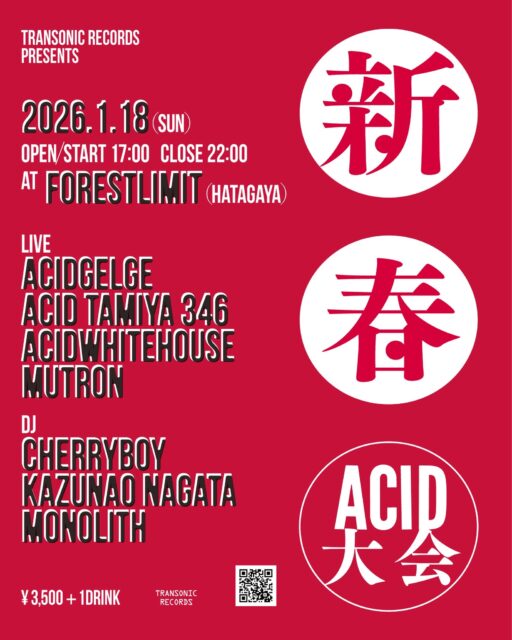
On January 18, 2026, Shinshun ACID Taikai (新春ACID大会 — literally “New Year’s ACID Gathering”) was held at FORESTLIMIT in Hatagaya, Tokyo.
The event was organized around participants of the ACID compilation (TRS-25037) released by TRANSONIC RECORDS in December 2025.
- Venue: FORESTLIMIT (KODA Building B1F 102, 2-8-15 Hatagaya, Shibuya-ku, Tokyo)
- LIVE: AcidGelge / ACID TAMIYA 346 / ACIDWHITEHOUSE / MUTRON
- DJ: CHERRYBOY / MONOLITH / KAZUNAO NAGATA
The venue was equipped with large speakers delivering powerful low-end bass you could feel physically throughout the floor.
Hypothesis: 90’s Rave Works Best Not as Direct Quotation, But as Fusion Material with Contemporary Genres
In recent years, tracks incorporating rave elements have been on the rise.
However, my own interest is not in “directly transplanting 90’s rave.”
What I want to test is whether blending the vocabulary of current techno and UK bass with the raw impulse of 90’s rave to create something entirely new can actually work on the floor.
Not nostalgic recreation, but whether fusion can generate a new kind of physical reaction.
Compared to the current trend of “music with rave elements,” my tracks intentionally push the concentration of rave density higher.
I wanted to see whether that density would be rejected on the floor — or whether it would produce a physical response.
Conditions on the Day
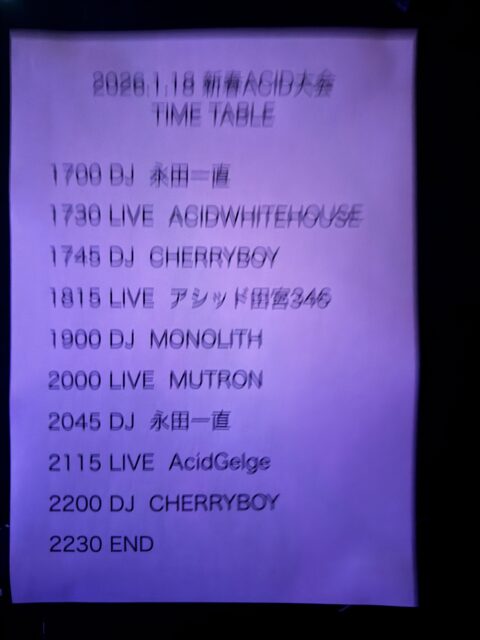
My slot was 6th, a 45-minute set starting at 20:00.
The crowd was already warmed up from the previous acts.
By the time I started, the floor was already in a great state.
The audience was primarily composed of musically knowledgeable people who understood the event’s concept.
A fair number had also been listening to my other tracks since the compilation release.
These conditions are an important premise for understanding the results.
(= The same outcome may not be replicated on a cold floor right after doors open.)
Live Design: Contrasting Gear, Fused Content
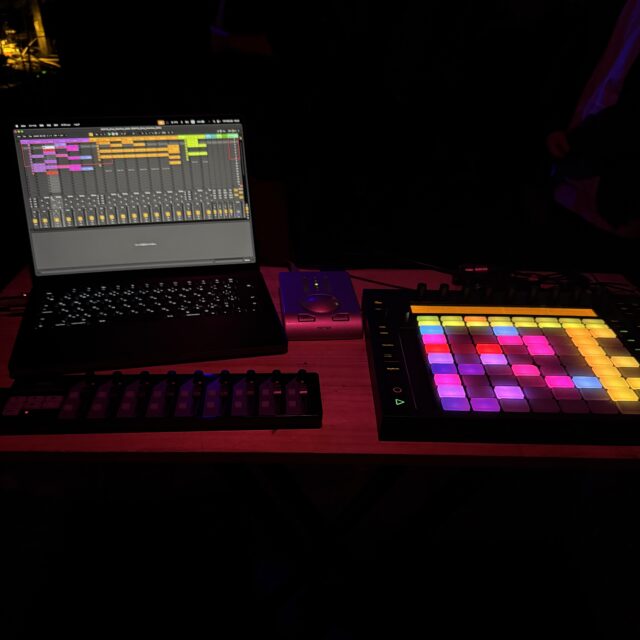
While most performers used hardware like TB-303 and TR-909, I performed with a minimal setup: MacBook Pro / Ableton Push / small MIDI controller.
The intention was not to make a statement about gear, but to focus on structure and reaction testing.
It also allowed me the flexibility to reorganize the set in real time as needed.
The set comprised 12 tracks:
- Released: 5 tracks
- Unreleased / made specifically for the show: 7 tracks
Crucially, all tracks — including released ones — were reconstructed for live performance.
This set was not a playback of finished recordings, but a “live version” rebuilt from scratch with track order, development, and structure all rethought based on expected floor reaction.
In terms of reading and adapting to the crowd in real time, the approach was closer to DJing than traditional live performance.
Setlist
- Future Sushi (breakbeat arrangement)
- Get Lost
- Cut the Midrange Drop the Acieeed Bass
- Unreleased
- Rage Against The Dominator
- RAVENATION
- Unreleased
- Unreleased (Beastie Boys “Intergalactic” sample)
- Unreleased
- Unreleased (track name: Doom)
- Unreleased (Hypnotist “House Is Mine” sample) — Planning to cut a 15-second clip from this part as a YouTube Short
- Unreleased (Manix “Feel Real Good” sample)
Findings: The Biggest Win Was Unreleased Tracks Holding the Energy
The crowd responded from the very first track — shouts and calls throughout — and even with unreleased tracks in the mix, the energy never dropped.
Existing tracks generating a response was expected, but what exceeded expectations was:
- Unreleased tracks also held their own, with multiple moments of clear crowd response
On the other hand, the Beastie Boys “Intergalactic” sample section didn’t build as much energy as I had hoped.
I’m taking this as a sign that the strength of the source material alone can’t create a peak — the placement and development design matters more.
Reproducibility: What Conditions Make This Work
Today’s results can’t be generalized.
However, I believe my set functions well when at least the following conditions are met:
- A context that accepts “rave” as a valid reference (a setting where strong hooks and samples are welcomed on the dance floor)
- A sound system capable of delivering proper low-end (conditions for physical response)
- A warmed-up floor, or the ability to design toward warming it up
- An audience that enjoys “fusion” with current genres rather than nostalgic recreation
The key point here is not 90’s rave as recreation.
It’s about targeting a different reaction through fusion with current techno, UK bass, and other contemporary genres.
Next Questions (Reproducibility)
Three points I want to test next:
- Reproducibility as a floor-designed live act
The fact that unreleased tracks held the energy is potentially evidence of “designability” rather than chance. - Increasing the precision of “fusion” (upgrading the mixing approach)
Based on insights from this show (e.g., the reaction gap with the Intergalactic sample), I’ll focus on improving placement, development, and break precision rather than just source selection. - Release selection based on floor reaction
I made an air recording on the day. I’ll use audience response — shouts, peaks — as criteria to narrow down which unreleased tracks are candidates for the next release.
Next Actions
- Listen back to the air recording and identify where the energy peaked
- Move unreleased tracks that worked on the floor to next release candidates
- Distinguish between “tracks to keep live-only” and “tracks to redesign for release”
Notes
This set was not built on the concept of replaying a finished, distribution-ready recording.
It was designed with the assumption that track order, development, and breaks would be reorganized to match the temperature and acoustics of the floor on the day.
The same track sounds different — and peaks differently — when listened to as a recording versus experienced live on the floor.
Going forward, I’ll apply the insights from this show (especially the finding that placement/development design matters more than source material strength) to improve both the fusion approach and peak precision.
For booking inquiries, please contact via the Consult page on this site.