(This post is based on information available as of November 2026.)
In this post, I want to think through what happens to ad-supported websites once everyone starts using AI agents.
Let me start with the conclusion. I think making a living from ads will erode, but for the people who create genuinely valuable information, it may turn out to be a tailwind. I’ll walk through why, step by step.
An AI agent is an AI that carries out the steps of research or shopping on your behalf. Ask it, “Compare hotels for my business trip using the reviews,” and it will read dozens of pages across news sites and blogs and hand you back just the answer. It’s convenient, but no human ever opens those pages. No ad is shown to anyone, and the sites that fund themselves with ad revenue from those pages earn nothing.
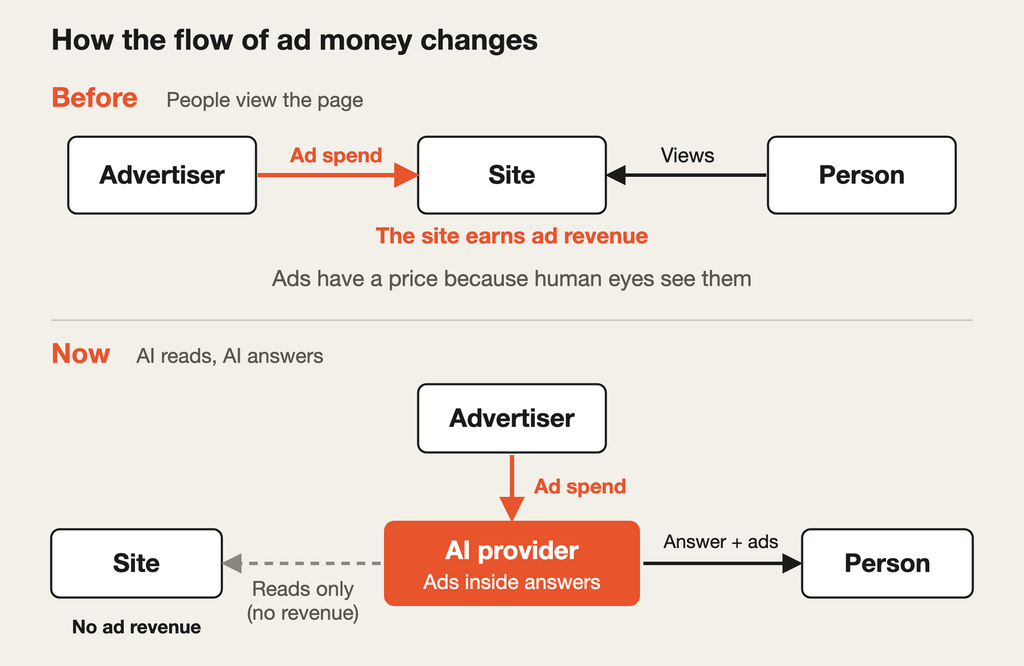
Do ads earn money on pages that AI reads?
No. An ad only turns into money when a person opens the page and actually sees it. Ads have a price because there are human eyes on them. If only an AI is reading, nobody sees the ad.
On top of that, when an AI summarizes the answer, fewer people open the original page at all. The page still gets read, but the reading no longer turns into revenue. Even so, it doesn’t look like ads themselves are about to disappear.
Ads moved into the AI’s answer
Ads have moved from the page into the AI’s answer. Google is already showing ads inside its AI-generated search answers (AI Overviews and AI Mode). They started in the US in 2025, and in October 2026 it was announced that they would expand to ten more countries. The ads are labeled “Sponsored.”
AI answers cost more to compute than ordinary search. Even so, I think that for queries where money is easy to make, such as shopping and comparisons, ad revenue could plausibly cover the cost. The evidence is thin, but a 2023 estimate by the analysts at SemiAnalysis put Google’s revenue at roughly 1.6 cents per search query and the cost of a ChatGPT-style AI answer at roughly 0.4 cents. That is an outside estimate, and an old one, not a figure Google has published. There are also suggestions that AI search today costs more, because it runs several searches behind the scenes.
The party that receives the money at the new destination is the AI provider. The sites that supplied the raw material don’t.
The sites that supplied the material aren’t just watching quietly, though. A movement to put a tollbooth at the entrance has started.
A tollbooth at the entrance of the page
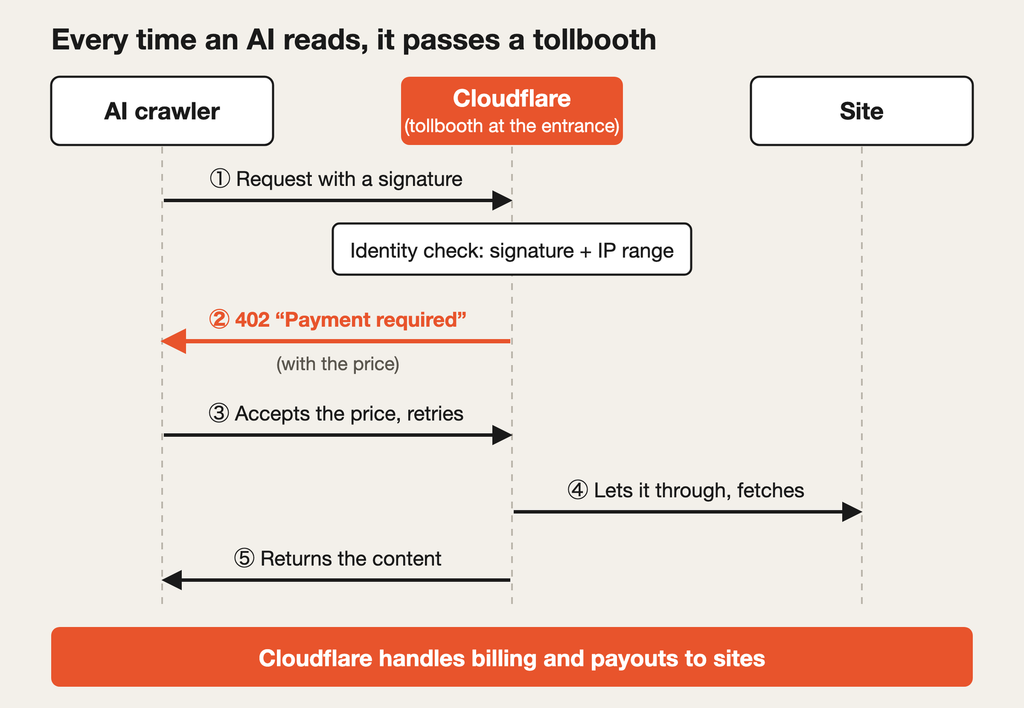
The idea is simple: if an AI is going to read it, charge for it. You put a tollbooth at the entrance of your site, and when an AI crawler shows up, you reply, “Payment required.”
The signal for this is an error code called “HTTP 402” (Payment Required). It was reserved back when the internet was being designed, but it has hardly ever been used.
One company trying to make this real is Cloudflare, which sits in front of websites and relays their traffic (a CDN). AI crawlers have a standard (Web Bot Auth) for attaching a signature to each request that proves who they are, and Cloudflare verifies that signature to tell whether a request comes from a registered crawler. It also checks the range of IP addresses the requests come from. I suspect it can’t fully identify crawlers that don’t sign their requests, but at the very least you can put a tollbooth in front of the big AI companies. This “pay for every read” feature (pay-per-crawl) launched as a limited beta in July 2025 and, as of 2026, is still in limited beta.
There is also a standard called RSL. It lets a site state its terms, “if you want to read this, here are the conditions,” in a machine-readable form. Version 1.0 was published in December 2025. Collective licensing bodies, much like music copyright societies, are being set up as well.
But an AI reads dozens of sites in the course of a single research task. Does it really pay every time?
Is paying site by site, every time, realistic?
I don’t think so. Signing a contract with each site and paying on every access is a hassle for humans and AIs alike.
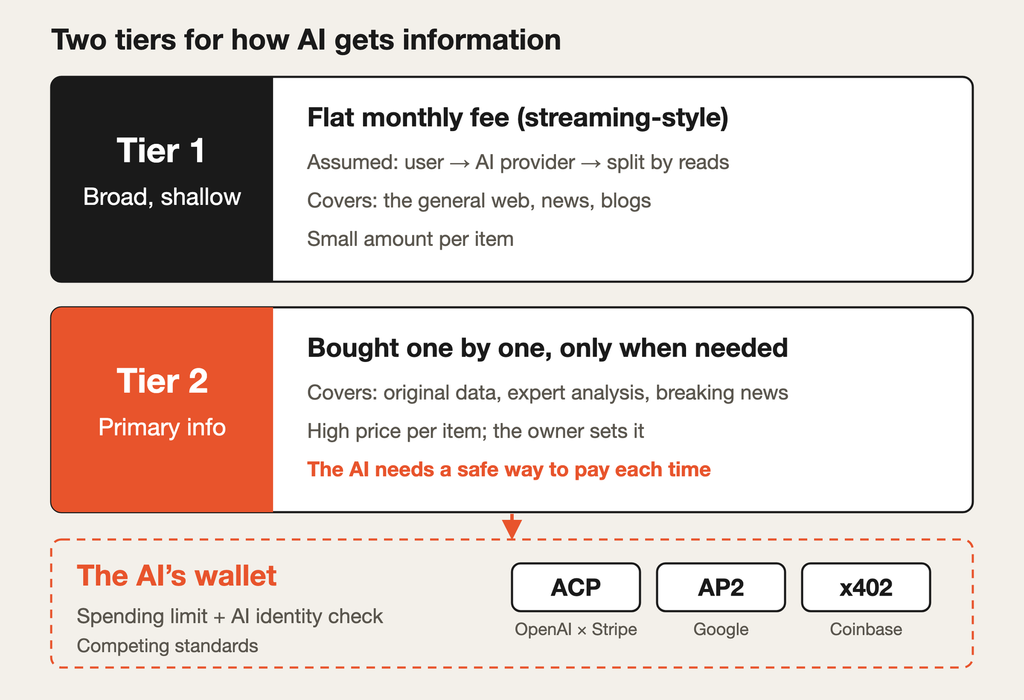
A more plausible model is something close to Spotify. Users pay the AI company a monthly fee, and the AI company distributes the money it collects to individual sites according to how much each was read. Users never have to think about the payments happening behind the scenes.
Then, is there no risk of being charged without realizing it? The price is shown before the content is read, so you won’t be billed after the fact for something you’ve already seen. But small amounts adding up, and an AI paying because of an instruction planted on a malicious page (prompt injection), are real risks. The AI side needs guardrails, such as a cap per request and a daily budget.
Still, the flat-fee approach seems to have a bigger weakness.
Can flat-fee money buy valuable information?
I think there will be parts it can’t reach. A flat-fee distribution splits the pooled money by how much was read, so the amount per item is small. That suits broad, shallow information such as the ordinary web.
Primary information, on the other hand (original data, expert analysis, breaking news, specialist databases) doesn’t pay off for its owners under that kind of pro-rata split. In fact, financial data and academic databases are already sold at high prices through individual contracts.
A music analogy: some people are happy with an all-you-can-listen streaming service, while others badly want one particular track and buy it. Streaming is the flat-fee model; buying the track is the individual one. I think information will probably split into two tiers in the same way: a first tier of broad, shallow reading, and a second tier where you buy primary information individually, only when you need it.
The question for the second tier is whether an AI can pay safely.
Who will build the AI’s “wallet”?
For an AI to pay individually, it needs something like a wallet of its own. The user sets a limit, “you can spend within this range,” and hands it over; the AI pays within that limit. The receiving side, too, needs to be able to confirm that the AI is genuine and authorized to pay on the user’s behalf.
Not only AI companies but also payment companies are entering the race to define this wallet’s standard. When you think of online payments, you think of Stripe, but that isn’t necessarily the case for AI. In September 2025, OpenAI teamed up with Stripe and released a standard (ACP) for completing a purchase inside a conversation with an AI. The same month, Google announced a standard for AI payments (AP2) together with more than 60 organizations, including Visa, Mastercard, and PayPal. And Coinbase, a crypto exchange, has released a method (x402) that uses the same 402 signal to let AIs pay in stablecoins (crypto assets pegged to the value of a currency such as the dollar).
I think each of them wants to spread its own standard and own the entrance to payments. Google already has a huge number of accounts with payment methods registered, so it is probably several steps ahead. That said, as far as I could find, I wasn’t able to confirm how far an AI “wallet” has actually progressed as a real product.
Is a system for buying primary information a viable business?
I think there is still a lot of open space around this. A few things come to mind. A storefront where sellers can easily price and offer their own data. A marketplace where an AI can find out what primary information exists, where, and at what price. Payments small enough to handle transactions worth a few cents to a few tens of cents. And budget management that lets you delegate to an AI without overspending.
Some players are already moving. TollBit is an intermediary service that puts a tollbooth at a site’s entrance so that an AI can pay to access it. Skyfire handles verifying the AI’s identity and small payments. In September 2025, Akamai (a CDN company like Cloudflare) announced partnerships with both. However, most of what’s available comes from the companies’ own announcements, and I couldn’t confirm their scale or results.
There are challenges too. The buyers are effectively limited to AI companies, competition tends to push prices down, and big players may lock people into their own systems. This isn’t a prediction; it’s just my view.
Should a personal site put up a tollbooth or leave the gate open?
I think each has pros and cons. If you charge, an AI may use another site that offers the same content for free. On the other hand, going free doesn’t mean the AI will choose you. Whether you get chosen depends less on price than on whether that information can be found elsewhere.
If it’s information you can’t get anywhere else, people will likely read it even behind a tollbooth. If it’s commonplace, it’s unlikely to be chosen even when free, and even when it is read, it earns nothing. For a personal blog, being mentioned in an AI’s answer has value in itself, so keeping the gate open for now is a perfectly reasonable choice.
What matters, I think, is being in a position where you can choose. If you simply put a site on a rental server, all you can do is write “please don’t” for a crawler that arrives, and whether it complies is up to the crawler. If you place an intermediary like Cloudflare in front of your site, you can choose to let traffic through, turn it away, or charge it. And if you put AI-built static HTML on Cloudflare, you can even run it on the free tier (comments and forms need other solutions).
The more AI sits in between, the more valuable “who said it” becomes
The more AI sits in the middle, the more summaries become something anyone can make. A summary of “everything about X” is something AI can produce endlessly. What will make the difference is “who said it.”
I see three reasons this could be a tailwind for individual creators.
First, summaries can be replaced, but “that person’s perspective” can’t. In music, AI can make a playlist, but it can’t make a particular DJ’s playing and track selection on a particular night. There remains a reason to be chosen by name.
Second, what you experienced, what you made, and data only you hold are primary information as they are. In the second tier, where things are bought individually, they carry value.
Third, it becomes easier to reach niches around the world. AI searches regardless of language or region, so even a small demand, gathered from all over the world, adds up to a viable number.
In fact, the analytics for this site also show visits that came from AI. It seems the flow, in which a site is introduced in an AI’s answer and a person comes from there, is already happening.
Of course, the tailwind blows only if an AI can find you and people choose you because of who you are. We need to think about both: keep the entrance open so you can be found, while keeping the option to decide how to sell what is truly valuable.
Making a living from ads may keep eroding. But the people who create valuable information won’t disappear. I think the paths along which money flows are simply changing.
When you hand your research to an AI, have you ever wondered whether any money reaches the sites it drew on?
Sources
- Cloudflare: Introducing pay per crawl
- Cloudflare: The age of agents (cryptographically recognizing agent traffic)
- Status of pay-per-crawl (ppc.land)
- Ads in Google’s AI Mode and AI Overviews (Search Engine Land)
- Estimates of search and AI costs (SemiAnalysis, February 2023)
- RSL 1.0 published (The Register)
- A comparison of AI payment protocols (Nordic APIs)
- Google’s AP2 explained (Spark)
- Akamai, TollBit and Skyfire partnership (Akamai)