If you make original music, it’s only natural to want someone to hear it. Broadly speaking, there are two ways to get your music heard: sending a demo to an existing record label and signing a release deal, or starting your own label and finding the people out there — wherever they are in the world — who’ll love your music, and reaching them directly.
These days, the spread of social platforms like Instagram, X, and TikTok has closed the distance between musicians and fans — direct communication and word-of-mouth are easier than ever. Technology has also made it far cheaper and less labor-intensive to get your music to fans than it used to be. In this shifting landscape, musicians don’t necessarily need to sign with an existing label anymore — you can find and reach the people out there who’ll love your music, entirely on your own.
This post is for musicians going it alone — a look at the best ways to get your music out to the world.
Update Log
Updated 2026.09.13: Updated pricing and Beatport support info for the digital distributors below. A lot has changed since this post was first written in 2020 — TuneCore now supports Beatport, SYMPHONIC’s previously-free tier now has a fee, amuse discontinued its free plan, and AWAL moved to an application-only model. Terms change quickly, so always check each service’s official site before signing up.
The Short Version
As of 2026, TuneCore is the lowest-barrier option if you’re starting a label from scratch. It runs from ¥4,400/year, has supported Beatport distribution since 2024, and its interface is entirely in Japanese if that matters to you. SYMPHONIC still requires an application, and the thing that made it my pick back then — a free tier — no longer exists (it’s now $29.99/year plus $10/month for Beatport). It’s no longer my top recommendation for someone starting from zero. See “Recommended Services” below for the full comparison.
Weighing Your Digital Distribution Options
If all you want is for people to be able to hear your music, you could just upload it to YouTube or SoundCloud — quick and simple. Create the account under whatever label name you’ve dreamed up, and congratulations, your one-of-a-kind label is born.
But as a musician, at some point you’ll want the tracks you poured yourself into to be available on the major platforms — Apple Music, Spotify, and the rest. The method above won’t earn you a single yen, but the one I’m about to describe will. And honestly, that hurdle has gotten a lot lower in recent years.
For physical distribution you’d go through a distributor; for digital, the equivalent is a digital distributor (aggregator). A digital distributor handles the entire process of getting your music onto the many download and streaming services out there — Apple Music, Spotify, and so on. The big platforms don’t open a direct signup window for individual musicians, and registering separately with dozens of services one by one is just as exhausting as knocking on every record shop’s door in person.
So how do you find the right digital distributor? There are a few things worth getting clear on first:
- Which distribution service is non-negotiable for you
- How much you’re willing to spend on distribution
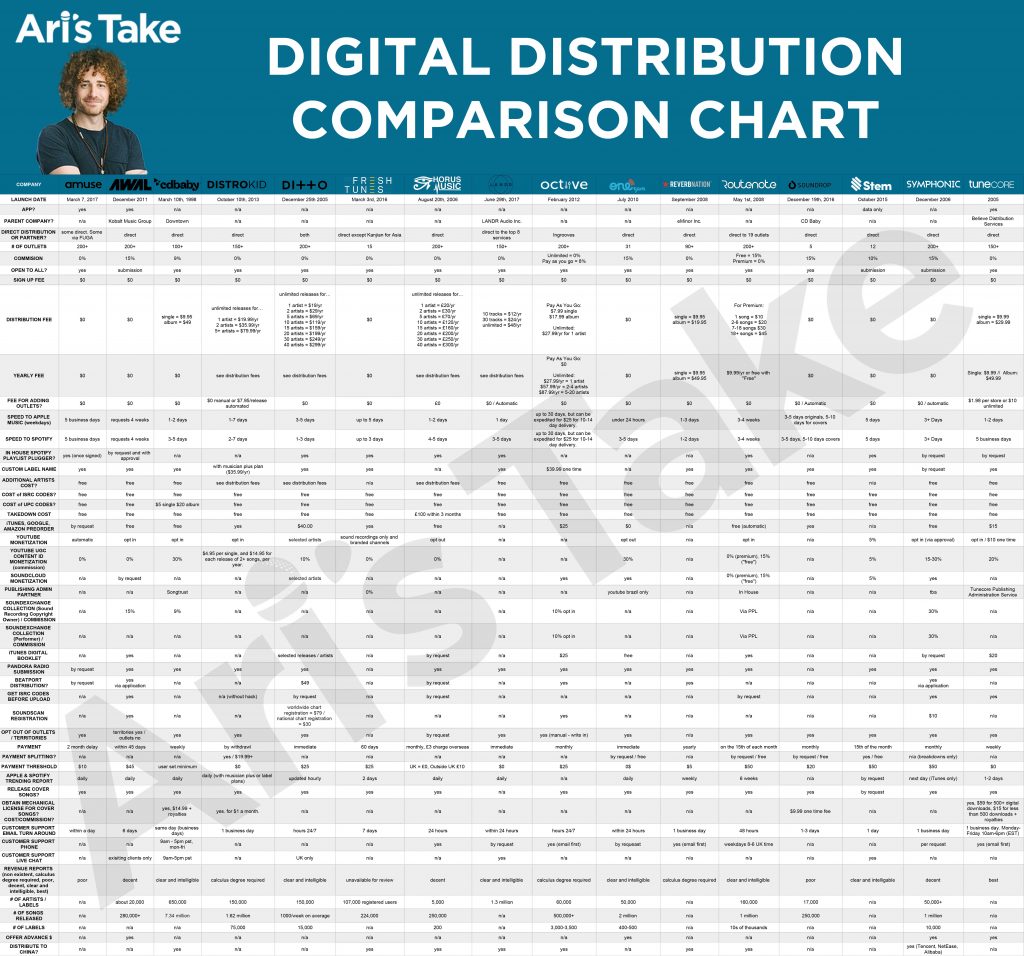
With those in mind, find the distributor that fits you from the many I’ll introduce below. The chart below is a list of 17 digital distributors from the site of LA-based musician and entrepreneur Ari Herstand (originally written in 2018, updated in May 2020 — terms have kept changing since, so it’s worth checking his site directly for the latest version).
Recommended Services
Getting a giant list of services dumped on you all at once makes it hard to decide — there’s too much to compare. So building on the points above, here’s what I personally weigh when choosing:
- How low the distribution cost is
- Whether it charges fees on past releases
- Whether it delivers to Beatport
- Whether it monetizes YouTube/SoundCloud plays
Weighing all that, here’s my ranking (accurate as of September 2026 — terms change quickly, so double-check each service’s site before signing up). Once you’ve found the distributor that fits, go ahead and register.
1. TuneCore (the strongest pick if you’re starting fresh)
I used to rank this last because it didn’t deliver to Beatport. That changed in 2024, when TuneCore partnered with Beatport — on the Unlimited plan, adding Beatport delivery costs $7.99/month. Maintenance costs are low: ¥4,400/year and up (Unlimited, unlimited releases) or ¥1,551 and up (Pay Per Release, per single). It’s still the only distributor with a fully Japanese interface, and royalties are 100% yours. If you’re starting from scratch today, this is my top pick.
2. SYMPHONIC (I still use this one)
The reason I picked this one back then was simple: there’s an application process, but it was free to maintain. That’s no longer true — it now costs a flat $29.99/year, plus a separate $10/month subscription for Beatport delivery (roughly $150/year in maintenance alone). Royalties are now 100% yours, but the “free” that sold me on it originally is gone. I’m still on it myself, mostly because of the cost of migrating my existing catalog elsewhere, but honestly, I don’t have a strong reason to recommend it as anyone’s first pick anymore. Once you’re approved, you do get a lot of operational freedom, so it’s worth considering once you’re looking to scale your label.
3. amuse
I used to steer clear of this one because it was free but didn’t let you operate under a label name. In March 2024 it dropped its free tier entirely — the plans now run from Artist ($23.99/year, one artist profile) up to Professional ($59.99+/year, three or more profiles). On the upside, the Professional plan now supports setting a label name, so the reason I originally avoided it no longer applies. Check the official site for the finer print on royalty rates.
4. AWAL
I used to describe this as roughly on par with SYMPHONIC. It’s now application-only, gated behind track-record requirements (think 4 million+ monthly streams or 10,000+ Spotify followers), which puts it out of reach if you’re just getting started. Fees run 15% at the Core tier (the entry level once you’re approved) and 20–30% at higher tiers. This is less something to consider on day one and more something to revisit once you’ve built up a track record.
There are plenty of other options too, even if none have a Japanese UI — DistroKid ($24.99/year, plus $9.99/month for Beatport) and Ditto Music ($19/year and up, though Beatport delivery requires setting up a separate “Beatport label” through them). If per-release cost and Japanese-language support are your priorities, though, TuneCore is still my top pick.
(A tangent) Don’t forget Bandcamp
Everything above is an aggregator bundling delivery to the major streaming and download services — Spotify, Apple Music, Beatport. Bandcamp sits outside that bundle entirely; you register and sell there directly, on your own. On “Bandcamp Friday” (held roughly eight times a year), Bandcamp waives its own cut, so almost the entire sale price — minus payment processing fees — goes straight to the artist, which is why it’s still widely used in dance music and electronic circles. It’s a separate track from the Beatport conversation above, but worth considering alongside it as a direct-sales channel and a way to connect with fans.
What to Do Once You’re Live
Once your track is registered with a digital distributor, there’s no time to relax — there’s more to do right away. I’ll walk through it in order: 1. Preparation, 2. Promotion, 3. Checking your results.
1. Preparation
- Set up social accounts for your artist name and label
- Apply for each service’s artist program
- Apply to Spotify for Artists
- Apply to Apple Music for Artists
- Apply to Amazon Music for Artists
- Create a smart link
It’s worth getting all of this done before your track actually releases. Some of these can take a while to set up, so start early with whatever you can. Many of you probably already have these, but in this day and age, having accounts on Instagram, X, TikTok, SoundCloud, and YouTube is basically mandatory for staying in touch with fans. YouTube has creator-focused tools, so make sure you can access YouTube Studio too. Your profile is usually the first thing people check before following you, so it’s worth putting real thought into what you write there.
Once your social accounts are set up, apply for each service’s artist program next. Once your music is live on Spotify, Apple Music, Amazon Music, and the rest, you’ll be able to see data like when, where, and how much it’s being played. Spotify also lets you edit your own artist page and choose which release to feature, among other ways to connect with fans.
Smart links are a big help when you get to the promotion step below. When you tell someone about your release, you have no idea which music service they actually use. But if you have one page that links out to every major service your music is on, that solves the problem — the person you’re telling can just find the link to whichever service they use and listen from there.
2. Promotion
- Reach out to fellow musicians
- Announce it on social media
- Pitch for playlist placement
- Reach out to media outlets
Once your track is out, start by telling your close friends and fellow musicians. They might recommend it to someone else, or if they like it enough, even offer to remix it.
Use the social accounts you set up earlier to announce the release to your fans. Sharing your smart link is the obvious move, but posting links to each major service individually can nudge up the odds of getting played too. Depending on how you use social media, you could reach a lot of people — it’s worth studying how other artists handle this.
Spotify lets you build your own playlists, and if a playlist is public, anyone can follow it and keep hearing whatever gets added going forward. Landing on a popular playlist is known to drive a lot of plays. There are now whole services built around playlist pitching, so there’s no reason not to submit to playlists that fit your sound — SubmitHub and Playlist Push are the well-known names, and SubmitHub even has a free tier. For more on getting your music covered beyond playlists, this article is a good reference.
Whether a music outlet — big or small — covers you comes down to an editor’s call, but reach out to the outlets you actually follow anyway. Are you telling yourself “no one’s going to cover my music”? Don’t — put in the work and craft a pitch that actually catches an editor’s eye instead. Outlets get pitched by people like you every single day. They’re looking for what’s novel or what a lot of people will want to see, and a pitch that doesn’t stand out is forgotten almost instantly. Study up on how to write a press release, think hard about what would actually catch someone’s attention, and your odds of getting covered go up considerably.
3. Checking Your Results
Time to check the numbers and see how your efforts have paid off. What matters most here isn’t landing a big payout — it’s how much your music actually gets listened to. Even a CD or a record won’t sell a second time if it never gets played once. Rather than one person listening once, aim for people listening 10 times, 100 times. Getting listened to strengthens your bond with fans, and the more of that bond you build, the more plays naturally follow.
Everything you set up in the preparation step gives you numbers to check. On X or Instagram, for instance, you can see how many people saw a given post and how many of them clicked through your link. If nobody’s clicking, your music downstream obviously isn’t getting heard either. Treat “getting listened to” as the finish line, and once you can trace where and how people are actually listening, what to do next starts to become clear.
Spotify for Artists shows you where geographically your track is getting the most plays. If, say, your track is doing unusually well in Russia, dig into why. If it traces back to a specific playlist, that means your pitching efforts actually worked. From there, you can target more playlists and outlets likely to reach Russian listeners specifically, driving even more plays — and maybe even a regional hit.
Apple Music for Artists also shows you how many times your track was identified on Shazam, the app that instantly tells you what song is playing. A rising number there means a radio host or club DJ played your track and someone in the crowd looked it up. If your music isn’t getting much traction otherwise, that might mean it’s worth targeting those tastemakers and discerning listeners directly instead.
This is the loop: use your results to figure out what would make the next round better, then actually go do it, and repeat. Keep at it, and the results will come.
One Last Thing
Thanks for reading this far. In an age where everyone’s on their phone, reading this much text might be exhausting, honestly (laughs). I trimmed it down as much as I could — I could’ve gone into a lot more detail. My goal here was to lay out, based on my own experience, everything I think you need to know to get a sense of the whole process of starting a one-person label.
If you have questions, want clarification, or think something here is flat-out wrong, feel free to reach out here. I hope this helps your music reach someone out there, wherever in the world they might be, who’s waiting to hear it.
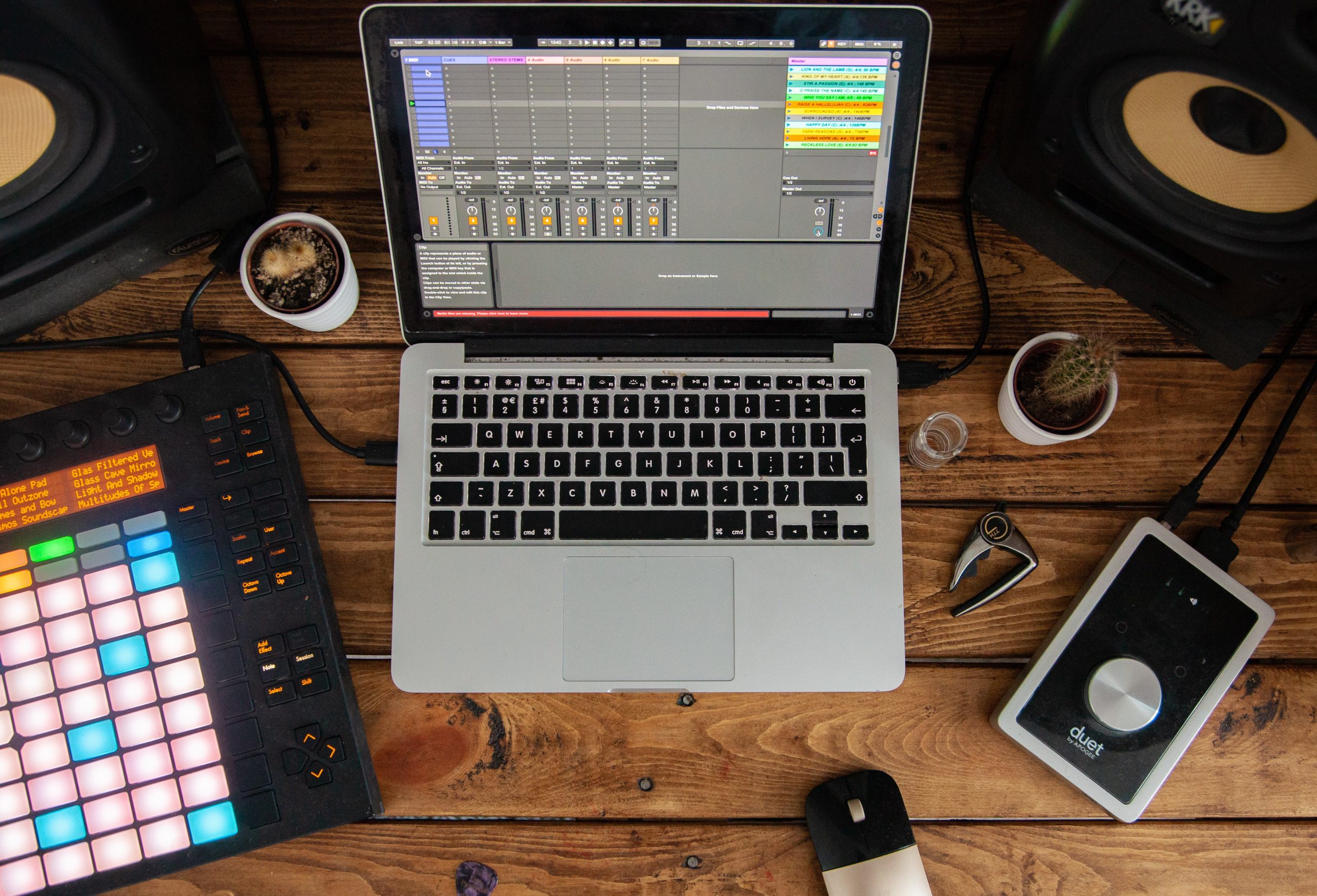
Photo by Duncan Kidd on Unsplash
Reference: The Basics of a Musician’s Business Model
Everything from here on is basic background — how musicians actually get paid in the first place. Skip ahead if you already know this part.
What Is a Musician’s Business Model?
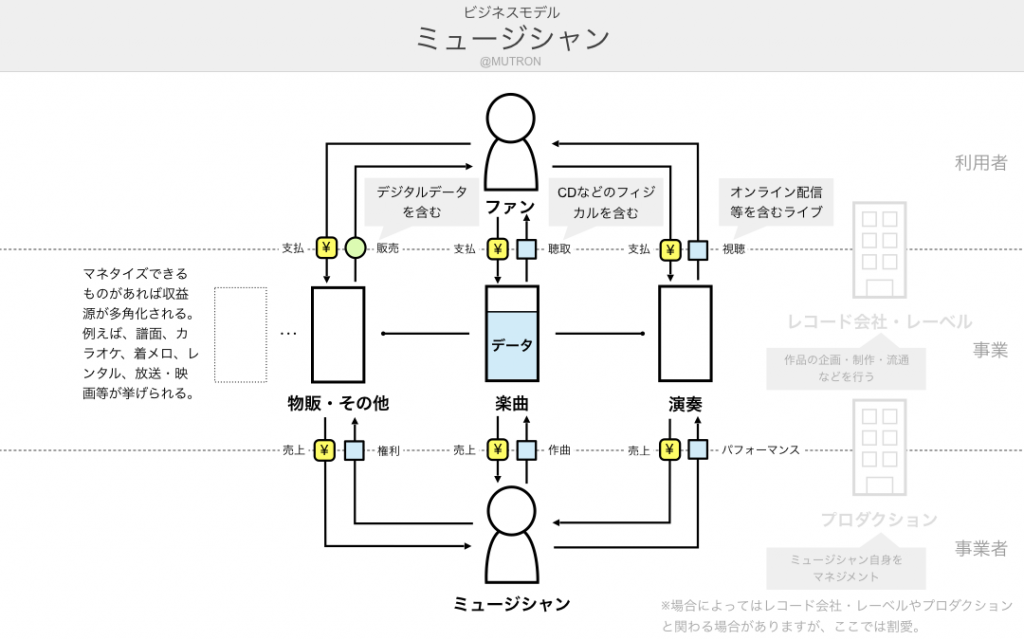
What does a musician’s business model — the mechanism for generating revenue and profit — actually look like? I’ve sketched it out in the diagram above, simplified quite a bit for clarity. If you’re not interested in getting paid, or you’re planning to make music purely as a volunteer effort, feel free to skip this part.
Musicians get paid in three broad ways:
- Making music. This splits into recording it as a physical product (CDs, records) or delivering it to fans digitally, as downloads or streams.
- Performing that music live. This also splits two ways: gathering fans at an actual venue, or streaming the performance online.
- Merchandise — turning anything connected to your music or performances into a product. Sheet music, DVDs of live footage, that kind of thing.
Beyond that — not shown in the diagram above — there are other paths too, like licensing a track for a film or a musician appearing in a TV drama.
How to Reach a Lot of Fans
In the business model section above, I mentioned two ways to turn music into a product: physical (CDs, records) and digital (downloads, streaming). Here, I’ll go into more detail on how you actually get that music to fans.
For physical formats, you first need mastering suited to that specific medium. Once mastering is done, CDs or records get manufactured at a pressing plant. Once the physical product exists, it gets delivered to stores willing to sell it and put on shelves — and only then can a fan finally pick up your music in their hands.
Here’s the catch: if you’re not signed to a record company, you have to handle production at the factory and logistics to every store entirely on your own. If you don’t have the mastering skills a given physical medium requires, you’ll need to hire a professional for that too. And if you actually want wide reach, signing with a distributor that already has a network of stores is a lot faster than tracking down shops one by one on foot. Just know that distributors will scrutinize you hard before signing — how well your music is likely to sell, how many future releases you’re planning — so go in prepared.
The biggest advantage of physical is that the object actually ends up in a fan’s hands, which builds a stronger bond than digital ever can. Per-unit prices are also higher than digital, so a sale has a bigger financial impact. The downside is the upfront investment required to manufacture anything — if your budget is small, no matter how good the music is, you’re limited in how many copies you can get to fans. There’s also inventory risk if it doesn’t sell; worst case, your own room ends up buried in unsold stock. On top of that, with how ubiquitous smartphones are now, CDs aren’t exactly convenient to listen to — some people love that about them, sure, but records take even more effort for the listener.
Digital — downloads and streaming — is the opposite: easy to listen to, but that same ease means the bond with fans tends to be thinner, so you need to lean on social media to make up the difference. The financial impact per sale is small, but margins are high, everything happens digitally, and you don’t need upfront investment in manufacturing or a distribution network. No risk of unsold stock taking over your room, either.
So, having read this far, which route do you think makes sense for a musician just starting out? My answer is unequivocally digital. The upfront investment can be kept small, and you can start with low risk — if you jump in on a whim and it doesn’t work out, you’ve lost almost nothing. If you’ve been on the fence about this, just start now. There’s no rush to try physical — you can always take a crack at it later, once you’ve found some success.